

Remember Two Things
...an eclipse blessing and a vegetal path under eclipse-light

The two things to always remember: When was the first eclipse of the Dragon Hole, and when was the second? Being that we are on the verge of #2, we are just hours away from slipping out of the dragon’s lair— but we just need to be aware of missiles and Baal this time around. It’s dangerous out there!
Now, I’m somewhat kidding (not sure about what part though). It’s good to remember those two things, but really, the purpose of this little stack is to point you towards a path you may be interested in, and also to share an interesting take on eclipses. All over the world, in the tellings of eclipse tales, we will always discover some beast eating the sun or moon for some reason: vengeance, hunger, spite, or simply for a good time. I used to have a tradition in the early days of sharing a different take on eclipses every six months; I’d like to resurrect that for us today, on the eve of this Lunar Eclipse in Virgo.
And so, the first thing to remember (truly): The connection between plants and planets. If you are serious about walking down this overgrown path, there is no better place to go than to Sajah’s school of Evolutionary Herbalism. This week, he’s sharing many FREE classes to get you hooked onto this green-star-studded path. Have a click to watch and learn more:

The second part of remembering is this Cherokee take on eclipses, and a toad named Walosi:
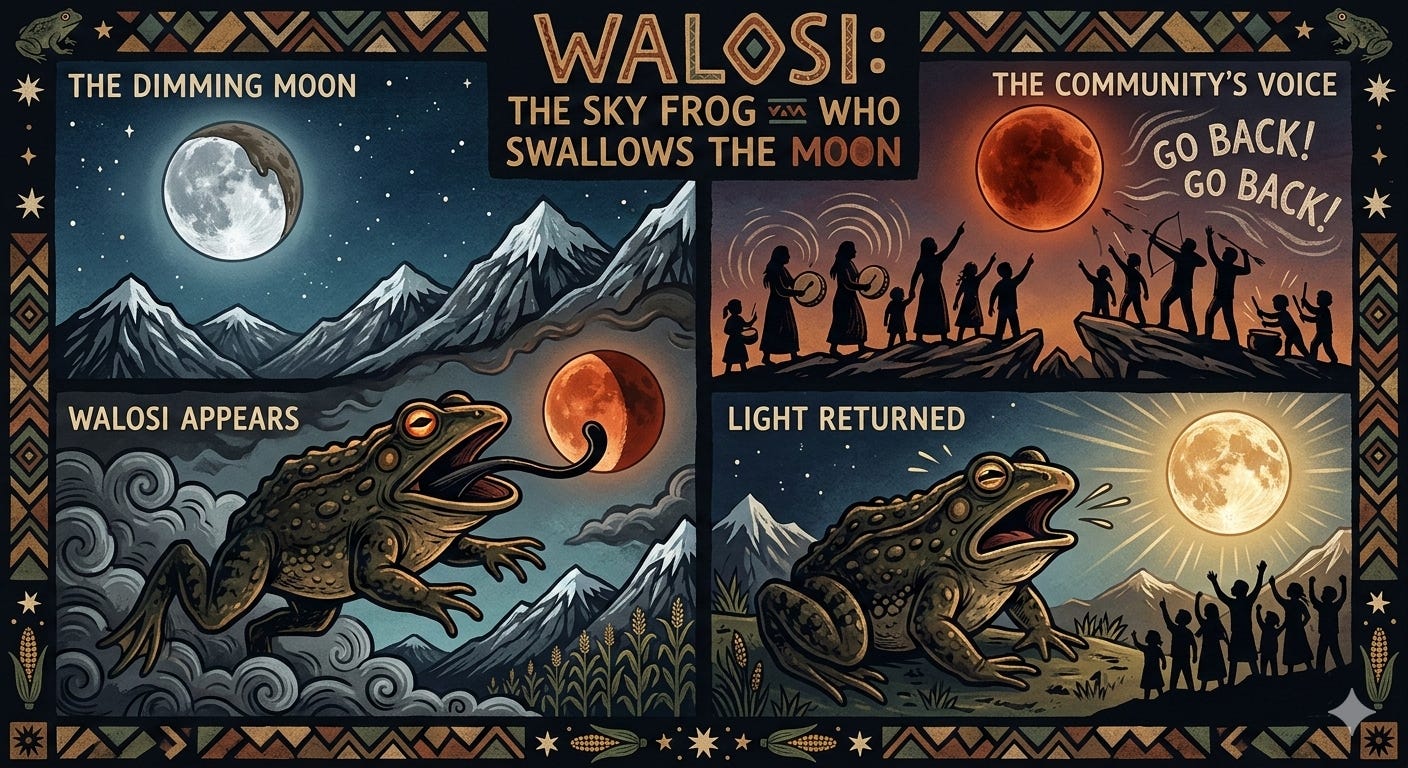
Walosi: The Sky Frog Who Swallows the Moon
Long before telescopes told us what eclipses were, people looked up at a dimming moon and asked the oldest question: What is eating the light?
For the Cherokee, the answer had a name: walosi.
Walosi is a giant frog — ancient, sky-dwelling, insatiably hungry — who appears in Cherokee oral tradition stretching back to pre-colonial times. When the moon begins to vanish, elders said walosi was swallowing it whole, slow bite by slow bite. The old Cherokee phrase captures it plainly: Nvdo walosi ugisgo — “the frog eats the round thing.” Sun or moon, it didn’t matter. Walosi wanted the light.
Eclipses, in that world, weren’t only astronomical events. They were emergencies. The sky was dying. So communities did what they had to do: they got loud. Women pounded drums. Men shot arrows into the dark. Children banged pots and screamed. The noise was the medicine — and it worked every time. Walosi would flinch, choke, and spit the moon back out. Then, the light returned. Balance was restored.
The frog wasn’t evil, the elders said. Just greedy. Nature’s reminder that nothing we love is permanent — and that keeping it requires effort.
Ethnographer James Mooney documented this tradition in Myths of the Cherokee in the late 1800s, but the story is far older, passed from mouth to ear across generations. And it’s not alone — similar frog-eating-the-moon myths surface in Vietnamese folklore and Hindu tradition. But the Cherokee version has something the others lack: no hero, no god, no divine intervention. Just a community, making noise together, refusing to let the dark win.
And so there you have it. If you watch tonight’s eclipse low over the peaks, listen close. You may just hear walosi, chewing — and waiting for the next bite as he delights upon the light.
remember: Keep your ground state. Don’t stare for too long, and consider doing your practice; it’s said to be 108x more potent when you do.
Oh, and if you didn’t click the Sajah image, you may want to scroll back up
all the best,
adam
to learn Astrology:
....to support my work and learn astrology all at the same time

to work with me:
...to schedule a reading


I watched it! Between 4 and 5 this morning. My little dog Henry got me up and as I watched I wanted to remember what I thought of such a sight in other lifetimes, before I knew it was our own shadow. Not a toad or a dragon, but us! getting in the way of light. I love this story and the empowering difference you call attention to.
Wonderful post 🙏🏼